Terrace Waterproofing Cost per Sq Ft – Existing Slab
Waterproofing of terraces that have been constructed earlier is meant to prevent leaks in buildings that are already in use, where deterioration has already begun. In such cases, the terrace waterproofing cost per sq ft for existing slab is usually higher due to surface damage, cracks, and repair requirements.
Over time, exposure to rainwater, weather conditions, and structural movement leads to cracking, weakening of the surface, and water penetration.
Terrace waterproofing cost per sq ft for existing slab in India usually ranges between ₹155 and ₹170. This price is not fixed because every terrace condition is different.
Some slabs need only surface treatment, while others require full dismantling, crack repair, and slope correction before waterproofing work begins.
The existing buildings have been subjected to years of weather elements including rain, heat, and other structural movement.
Because of this, common issues include cracks, internal moisture, old coating failure, and uneven slope. This is the reason that existing slabs are treated using an extensive repair and restoration process.
The process will include the removal of layers, preparation of a strong base layer, crack repairs, slope adjustment where water is stagnating, and installation of a full waterproofing system.
When the above procedure is followed effectively, the building is shielded against leakages and other problems.
However, when some corners are cut, even a well-selected material will not withstand for years.
Why Existing Slab Waterproofing Is More Complex
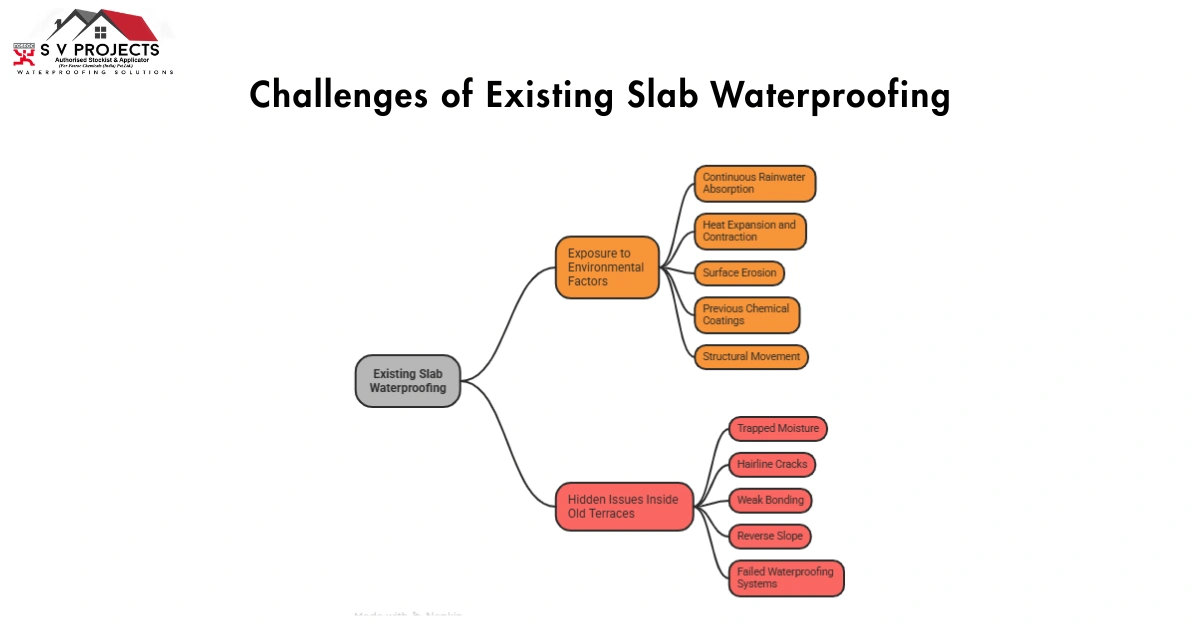
This is why terrace waterproofing cost per sq ft for existing slab is higher compared to new slabs. An old terrace is not a clean surface and usually has hidden damage within multiple layers of construction.
Over time, a slab is exposed to:
- Continuous rainwater absorption
- Heat expansion and contraction
- Surface erosion
- Previous chemical coatings
- Structural movement
These factors create internal damage that is not visible from outside.
Hidden Issues Inside Old Terraces
Most leakage problems come from:
- Trapped moisture inside old layers
- Hairline cracks beneath flooring
- Weak bonding between old screed and slab
- Reverse slope or uneven settlement
- Failed previous waterproofing systems
Because of these issues, direct coating never works on existing slabs.
Terrace Waterproofing Cost per Sq ft for Existing Slab
Final terrace waterproofing cost per sq ft (existing slab) = ₹155 – ₹170 depending on condition.
Approximate Cost: ₹155 – ₹170 per sq ft
This cost includes full system execution such as:
- Dismantling of existing flooring
- Surface preparation
- Crack repair
- Waterproof coating system
- Bonding layer
- Slope correction
- Screed protective layer
Why Cost Is Higher Than New Slabs
Existing slab work costs more because:
- Old materials must be removed
- Surface condition is unpredictable
- More crack treatment is required
- Slope correction is often needed
The cost reflects repair complexity, not material price alone.
Additional Work Required Before Waterproofing
Dismantling Existing Flooring
Before starting waterproofing, old layers must be removed completely.
Work Includes:
- Breaking old tiles or screed
- Removing damaged waterproof layers
- Cleaning exposed concrete surface
Why This Step Is Critical, If old layers are left behind:
- New coating will not bond properly
- Hidden moisture remains trapped
- Early failure becomes unavoidable
Step-by-Step Waterproofing Process
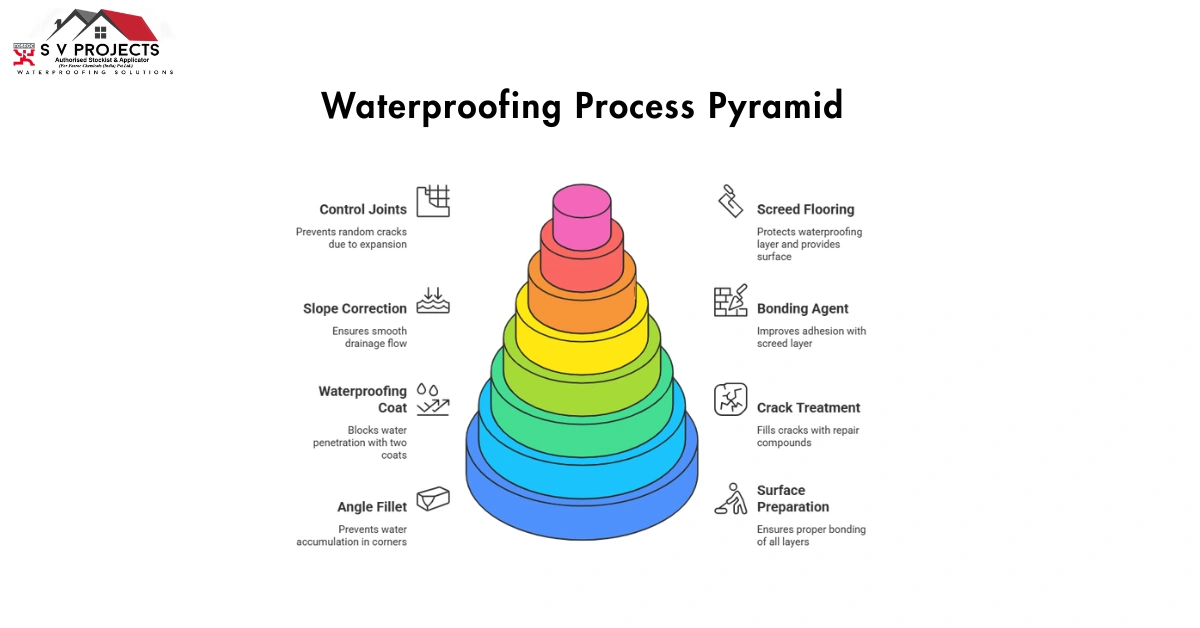
1. Surface Preparation
Cost: ₹10/sq.ft
This is the base of the entire system.
Work Includes:
- Cleaning slab surface thoroughly
- Removing dust, algae, and loose particles
- Exposing sound concrete layer
- Mechanical or manual grinding if needed
Importance:
A clean surface ensures proper bonding of all layers.
2. Angle Fillet / Galtha Work
Cost: ₹10/sq.ft
Corners are the weakest points in any terrace.
Work Includes:
- Creating smooth curved fillet at wall junctions
- Using polymer-modified mortar
Why It Matters:
- Prevents water accumulation in corners
- Reduces crack formation
- Improves coating durability
3. Crack Inspection and Treatment
Old slabs usually contain multiple cracks.
Work Includes:
- Identifying visible and micro cracks
- Opening cracks for proper filling
- Filling using crack repair compounds
Technical Perspective:
Cracks require structural treatment prior to waterproofing. It cannot be fixed just by applying coating.
4. Waterproofing Coat for Cementitious Material (Two Coats)
Cost: ₹45/sq.ft
This is the main waterproofing barrier.
Work Includes:
- First coat applied evenly
- Proper curing time maintained
- Second coat applied cross-directionally
Function:
- Blocks water penetration
- Bonds with concrete surface
- Forms protective waterproof layer
5. Bonding Agent Application
Cost: ₹10/sq.ft
Work Includes:
Application of bonding chemical layer
Purpose:
- Improves adhesion with screed
- Prevents layer separation
- Strengthens system life
6. Slope Correction – Critical Stage
Waterproofing fails most often due to the wrong slope.
Ideal Slope:
- 1:100 to 1:120
Work Includes:
- Identifying water stagnation areas
- Filling low zones
- Ensuring smooth drainage flow
Even a small flat area can cause long-term leakage.
7. Screed / Protective Flooring
Cost:
- Material: ₹45-50/sq.ft
- Labour: ₹25-30/sq.ft
Work Includes:
- Cement mortar screed layer
- Thickness: 40-75 mm
Proper finishing and leveling
Purpose:
- Protect waterproofing layer
- Maintain slope
- Provide durable surface
8. Control Joints (2×2 Grid System)
Why Needed:
Expansion and contraction of the material takes place because of the change in temperatures.
Work Includes:
- Cutting joints in grid pattern
- Filling with flexible sealant
Benefit:
- Prevents random cracks
- Improves structural durability
Key Differences – Existing vs New Slab
- Factor
- New Slab
- Existing Slab
Surface condition:
- Clean
- Damaged
Crack level :
- Low
- High
Dismantling :
- Not required
- Required
Risk level :
- Low
- Medium to High
Cost :
- Lower
- Higher
Existing slab waterproofing is a repair + reconstruction system, not just coating work.
Common Problems in Existing Terrace Waterproofing
Hidden Moisture
Trapped water reduces bonding strength.
Improper Dismantling
Old layers left behind cause failure.
Reverse Slope
Water stagnates even after work completion.
Ignored Cracks
Cracks reopen under pressure.
Poor Adhesion
New layers separate from the old surface.
Technical Factors That Decide Performance
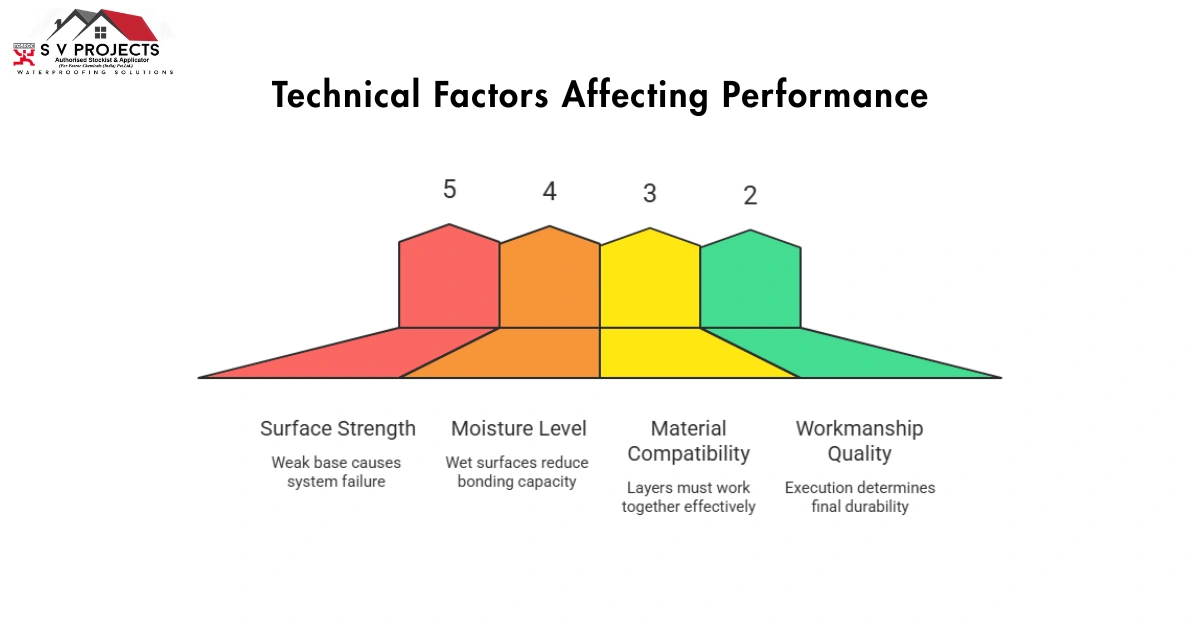
Surface Strength
Weak base leads to system failure.
Moisture Level
Wet area surfaces reduce bonding capacity.
Material Compatibility
All layers must work together.
Workmanship Quality
Execution determines final durability.
Expected Life of Waterproofing System
Lifespan: 5 to 10 years
Depends on:
- Material quality
- Work execution
- Weather exposure
- Maintenance
Water Ponding Test
What It Is:
Water is stored on the terrace for 24-48 hours.
Purpose:
- Detect leakage points
- Check slope performance
- Validate system integrity
This is the final quality confirmation step.
Maintenance Guidelines
After waterproofing:
- Keep drains clean
- Avoid heavy surface damage
- Inspect yearly
- Repair small cracks early
Advanced Waterproofing Failures and Root Cause Analysis
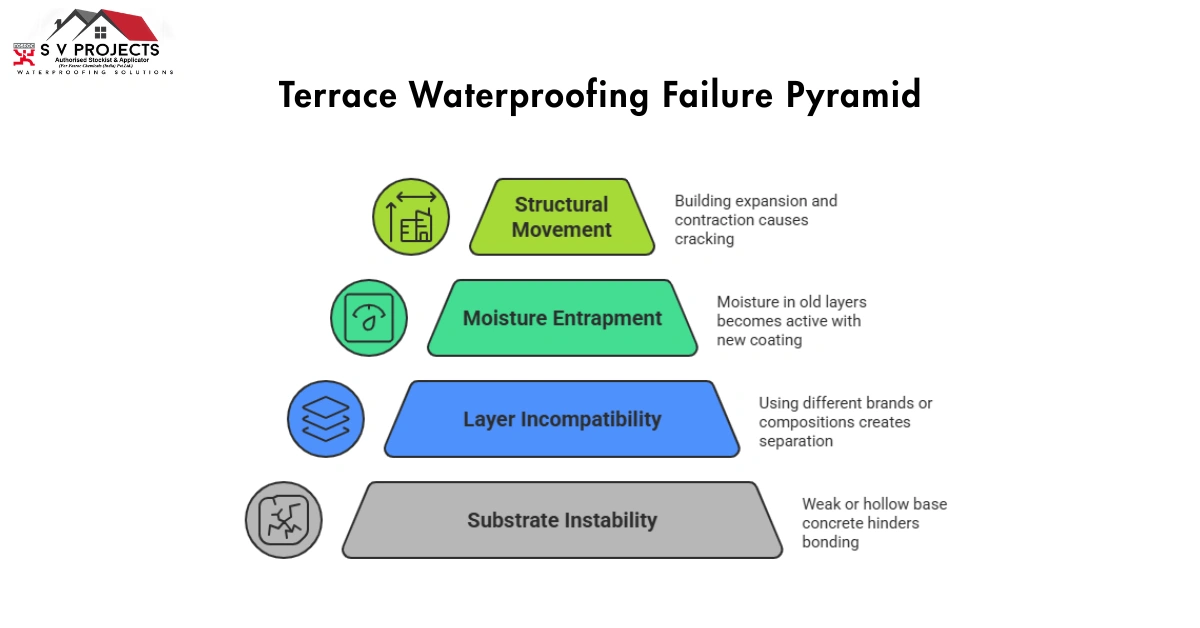
Most terrace waterproofing failures are not sudden. They develop slowly due to hidden execution mistakes that are not visible during or immediately after work.
Failure Due to Substrate Instability
If the base concrete is weak or hollow in certain areas, waterproofing layers cannot bond properly.
Over time, these weak zones expand due to moisture pressure, leading to localized leakage.
Incompatibility of the Two Layers in Terms of Chemistry
This incompatibility is achieved by using two different layers (brand or composition).
This creates micro-separation zones where water slowly penetrates.
Moisture Entrapment Under Old Layers
In older floors, there is moisture entrapment within the old screed/tiles, which becomes active when a new coating is applied.
Pressure is created from within, pushing the coating layer outwards.
Structural Movement Not Accounted
Buildings naturally expand and contract. If expansion movement is not controlled using proper joints, stress accumulates and leads to random cracking in waterproofing layers.
Advanced Material Behavior in Long-Term Performance
Waterproofing performance is not only about application it is also about how materials behave over time under environmental stress.
Cementitious System Hydration Cycle
Cement-based coatings undergo a process of curing even after the first stage of hardening.
Inadequate curing results in microcracking because of fast drying out of moisture, resulting in poor future strength.
Resistance Against Thermal Expansion
The terrace floor experiences very high temperature fluctuations. Good quality waterproofing systems withstand thermal expansion without separation from the surface or cracks formation.
Factor Controlling Capillary Water Transfer
Capillary movement of water continues to occur even with the installation of waterproofing coatings in concrete. Good waterproofing coating design reduces capillary transfer of water.
Factor Controlling UV Damage
UV light deteriorates the quality of the applied waterproofing coating.
Without the screeding process, the coating becomes brittle due to UV exposure.
Structural Load Impact on Waterproofed Terraces
Waterproofing systems are not isolated layers; they work under constant structural load conditions.
Static Load Influence
Permanent loads like water tanks, parapet walls, and flooring materials create pressure points. If load distribution is uneven, it can compress waterproofing layers and cause micro-cracking beneath.
Dynamic Load Stress
Movement caused by people walking, maintenance work, or shifting equipment creates repetitive stress cycles.
Over time, this leads to fatigue in coating layers if protection screed is insufficient.
Point Load Damage
Sharp or concentrated loads (like heavy objects placed on small areas) can puncture or weaken the screed layer, indirectly affecting waterproofing integrity below.
Load Transfer Misalignment
If screed is not properly bonded with a waterproof layer, load transfer becomes uneven.
This separation reduces system strength and increases risk of delamination.
Long-Term Maintenance Engineering Strategy
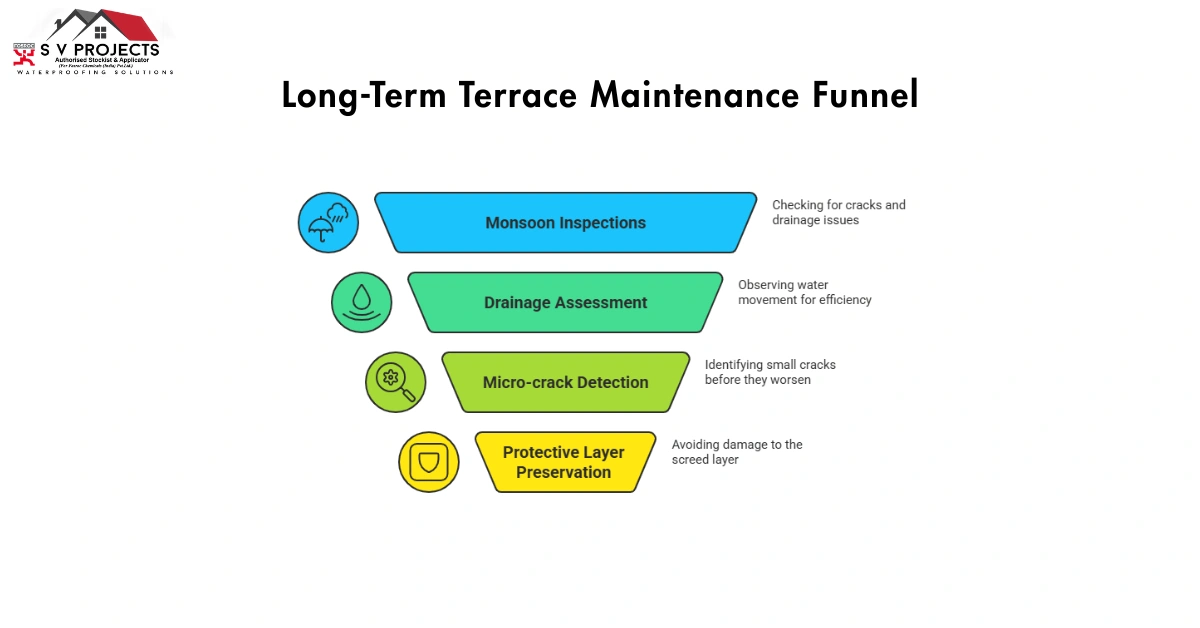
Waterproofing durability depends heavily on how the terrace is maintained after execution.
Terraces’ Inspection During Monsoon Seasons
Before and after the rainy season, terraces need to be inspected in order to spot any potential cracks, drainage problems, or wear-and-tear that may occur.
Terraces’ Drainage Effectiveness Assessment
The drainage system’s efficiency is very important for the terrace’s performance irrespective of its water-resistance. It is vital to observe the movement of the water so that drainage is properly done.
Micro-cracks Detection
The micro-cracks do not lead to any leakage problems, but they will gradually affect the building’s structure since water may start seeping through them.
Protective Layer Preservation
The screed layer serves as a protective layer against wear and tear. Drilling and impact can be avoided to help conserve system longevity.
SV Projects Waterproofing Experts
SV Projects Waterproofing Specialists was incorporated in the month of May 2015 by Mr. Kallu Sarva Reddy. It is located at Nagole, Hyderabad. SV Projects have more than 16 years of experience in offering their services of waterproofing and maintenance.
SV Projects team consists of over 100 laborers, 10 supervisors, and two civil engineers who monitor every step of the process to guarantee the success of the project. Moreover, SV Projects has been granted distributorship rights for renowned brands like Dr. Fixit, Fosroc, MCrete, and MYK Schomburg.
They offer their waterproofing services throughout Hyderabad for standalone homes, flats, commercial properties, industries, and corporate offices.
All projects come with a warranty of 3 years.
Final Conclusion
Terrace waterproofing for existing slabs is a technical restoration process, not a simple coating job.
The terrace waterproofing cost per sq ft – existing slab (₹155-₹170) reflects the complexity of restoring a damaged structure and rebuilding it layer by layer.
When executed correctly, it protects:
- Structural strength
- Interior spaces
- Long-term repair costs
A properly executed waterproofing system protects the structure for 5-10 years and prevents expensive repair work.
But if execution is poor or steps are skipped, leakage can return within a few years even with good materials. For terrace waterproofing in Hyderabad, Sv project waterproofing provides inspection and complete execution services.
For reliable and long-lasting waterproofing services in Hyderabad, contact SV Projects Waterproofing Experts on WhatsApp: +91 9949954566
